
Dating app “security” has become one of the most overused phrases in the industry.
Many platforms talk about safety. They highlight blurred photos, incognito modes, distance controls, private albums, screenshot alerts and visibility settings. These features can be useful. They can help users manage what other people see inside the app.
But they are not the full definition of protection.
For LGBTQ+ users, real safety starts much earlier.
It starts before a profile becomes visible.
Before a message is sent.
Before a location appears on a map.
Before personal information becomes part of a platform’s data system.
It starts with one basic question:
What data is collected, how long is it stored, and does it need to exist at all?
That question should define the next generation of safe LGBTQ+ dating apps.
Dating app privacy is no longer a niche issue
For years, the so-called free dating app economy has relied on something more valuable than subscriptions: identity-linked data.
This information does not simply improve user experience. In many digital business models, it becomes part of advertising systems, tracking networks and profiling technologies designed to turn behavior into commercial value.
For some users, that may sound abstract.
For LGBTQ+ users, it can become very real.
In many parts of the world, being openly LGBTQ+ is still legally, socially or politically dangerous. Even in open societies, digital traces can enable outing, harassment, blackmail, doxxing, stalking and discrimination. Human Dignity Trust’s map of jurisdictions that criminalise LGBT people
That is why gay dating app privacy cannot be treated as a nice-to-have feature.
Online behavior.
Location signals.
Connections.
Preferences.
Visibility.
Presence.
Device information.
Interaction patterns.
It is a safety issue.
When identity-linked data is widely collected and centrally stored, it becomes more than data.
It becomes exposure.
The problem with cosmetic dating app security
Most major dating apps define safety at the interface level.
Can I hide my profile photo?
How can I block another user?
Is it possible to control distance visibility?
Can I appear offline when using the app?
Does u2nite include a private mode?
These are valid tools. Users need them.
But they only answer one part of the problem.
The deeper question is architectural:
Where is profile data stored?
Is location data retained?
Are email addresses or social profiles linked to user identity?
Is behavior used for advertising-based profiling?
How much data exists outside the user’s direct control?
What remains in the system when the user is no longer active?
This is where the real difference begins.
Feature-based security manages visibility. Structural security reduces exposure.
A dating app can offer many privacy features on the screen and still collect extensive behavioral data in the background. That is why the best LGBTQ+ dating apps should not be judged only by what users see in the interface.
They should be judged by how they are built.
Download u2nite today
Why LGBTQ+ dating app security needs a different standard
Mainstream dating apps operate in a broad consumer category. LGBTQ+ dating apps operate in a more sensitive reality.
For queer users, dating is not always just dating. It can involve questions of identity, safety, visibility, legal risk, family pressure, social stigma and personal freedom.
In some regions, LGBTQ+ people use dating apps because offline spaces are limited or unsafe. In other regions, digital platforms are among the few ways to find community, support, friendship or love.
That makes the responsibility of LGBTQ+ dating platforms much higher.
A secure gay dating app should not only help people hide from unwanted attention inside the app. It should reduce the amount of identity-linked data that could ever be exposed, correlated, sold, misused or demanded.
That is the difference between safety as a feature and privacy as a foundation.
2025 made the dating app data economy visible
Recent public reports have made one thing clear: dating app data does not always stay where users believe it stays. Reuters reported allegations involving TikTok, Grindr and AppsFlyer
Privacy groups and media reports have raised concerns about third-party tracking, advertising relationships, data-sharing practices and the handling of highly sensitive information across major digital platforms.
Grindr has faced legal and regulatory pressure in Europe over data-sharing allegations. A London lawsuit filed in 2024 alleged that sensitive user information, including HIV-status-related data, had been shared with third parties without proper consent. Grindr has denied that it shared user-reported health information for commercial purposes. Reuters reported on the UK data lawsuit against Grindr
Other investigations into major dating app groups have raised broader questions about user safety, abuse reporting and platform accountability. The Markup investigated safety failures across Match Group dating apps
These cases point to a structural reality:
When identity-linked data becomes a business asset, incentives influence how much is collected, how long it is retained and how widely it circulates.
For LGBTQ+ users, that matters.
Because when identity can become data, data can become risk.
Why this goes far beyond Silicon Valley
Digital dating does not happen in a neutral world.
Political climates change.
Laws change.
Governments change.
Social pressure changes.
Public attitudes change.
But stored data can remain.
Human rights organizations have documented serious risks for LGBTQ+ people in countries where digital communication, dating apps or online identity can be used for harassment, blackmail, arrest, surveillance or public exposure.
Uganda has seen reported abuse and discrimination against LGBTQ+ people following the country’s Anti-Homosexuality Act. Amnesty International has also reported a wave of arrests targeting LGBT individuals in Tunisia. Media reports from Ghana have documented blackmail, extortion and violence connected to queer online dating. In China, major gay dating apps have been removed from app stores under government pressure. Russia’s “LGBT extremism” designation has further intensified the risks around visibility and digital expression. Human Rights Watch documented abuse against LGBT people in Uganda
These are different countries, different systems and different legal realities.
AP News reported on the removal of gay dating apps in China
Human Rights Watch reported on Russia’s LGBT “extremism” designation
But the lesson is the same:
Privacy is not only about comfort. For many LGBTQ+ users, privacy is the condition that makes connection possible.
That is why a safe LGBTQ dating app must be built differently from the start.
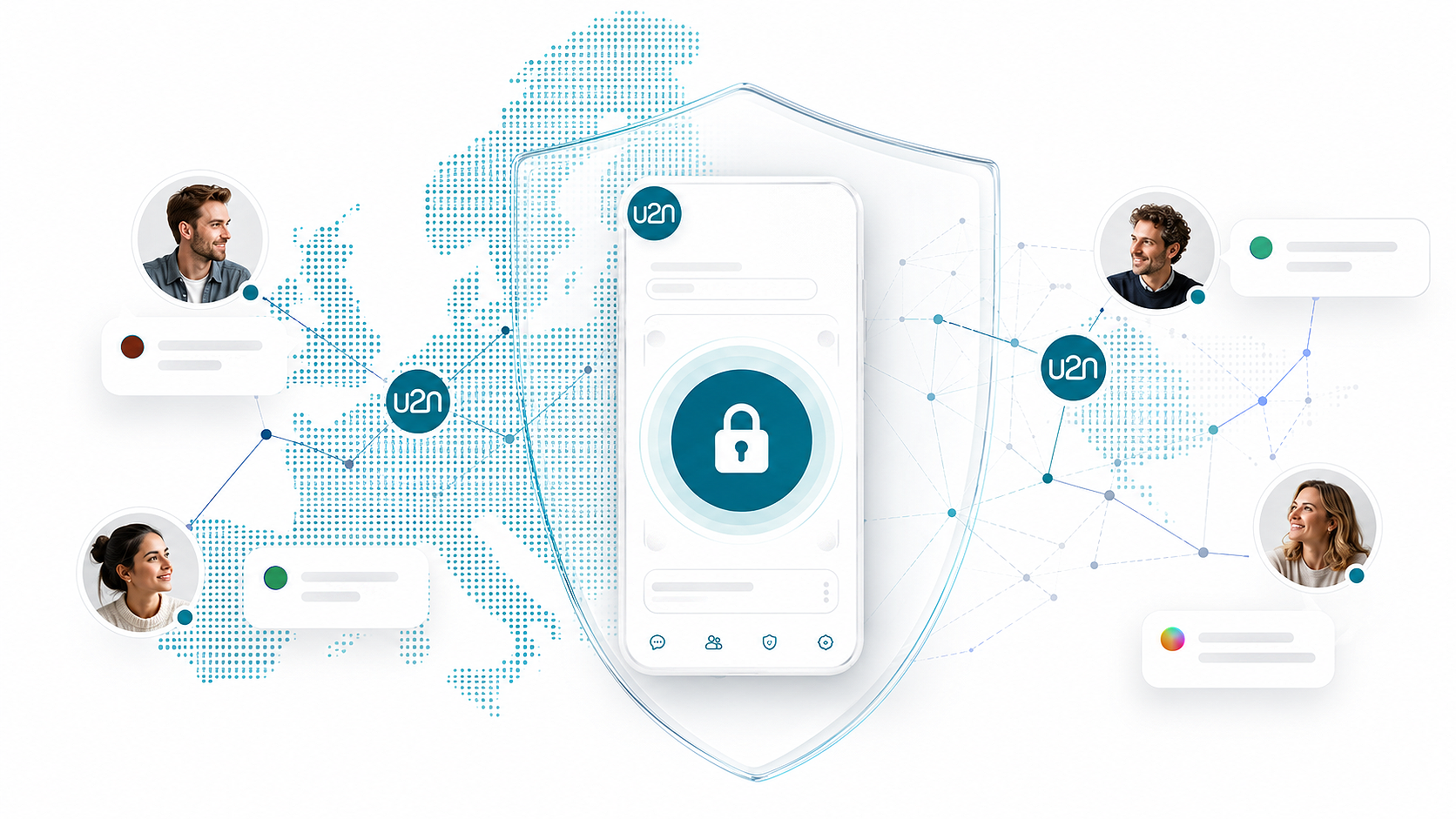
u2nite was built against the extraction model
At Wildtrolls, we built u2nite on a different premise.
If identity-linked data can be monetized, correlated, exposed or weaponized, the safest approach is to reduce how much of it exists in centralized systems in the first place.
“We built u2nite against the prevailing extraction model,” says Ivar M. M. Våge, CEO of Wildtrolls. “Most platforms are designed to generate value from identity data. We designed u2nite to reduce exposure at the architectural level.”
This is not an interface adjustment.
It is a structural decision.
u2nite is designed around data minimization, privacy by design and user-controlled visibility. The goal is not to collect broadly and manage risk later. The goal is to reduce exposure before risk is created.
What privacy-first architecture means in practice
A privacy-first LGBTQ+ dating app should not ask for more identity data than it needs.
u2nite is designed to reduce reliance on direct identity hooks such as email addresses, personal contact data or social profile connections. This limits the connection between a dating profile and a real-world identity.
Core profile data is designed to remain primarily under user control. Centralized exposure is limited to what is technically necessary for functionality. The platform is not built around advertising-based profiling or selling personal information.
Visibility is user-controlled. Location exposure is treated as a safety issue, not a growth tool. Communication is designed with modern security standards in mind.
The principle is simple:
If identity-linked data is not centrally retained, it cannot become a large-scale asset — and it cannot become a large-scale vulnerability.
That is structural security.
Why “no GPS tracking” matters in LGBTQ+ dating
Location is one of the most sensitive forms of data in any dating app.
For LGBTQ+ users, exact location exposure can create real-world risk. It can reveal where someone lives, works, studies, meets others or spends time. In hostile environments, this can become dangerous.
That is why u2nite does not build the experience around exposing precise real-time location to other users. Instead, u2nite focuses on controlled visibility and safer discovery.
Connection should not require unnecessary exposure.
A dating app should help people meet — without turning their whereabouts into a vulnerability.
Safer dating also means safer meeting
Online safety does not end in the chat.
At some point, many users want to meet in real life. That moment should not be left entirely to chance, especially when someone is in an unfamiliar city or region.
u2nite’s meeting concept is designed around safer public places. Instead of pushing users into direct location exposure, the app can suggest public meeting spots such as cafés, museums, galleries or parks.
This reflects a simple belief:
Dating should be exciting.
It should be human.
It should be fun.
But it should not require unnecessary risk.
Privacy-first dating is the next platform shift
The dating app industry has spent years optimizing for growth, engagement and monetization.
But the next platform shift will be trust.
Users are becoming more aware of how digital services collect and use personal information. Regulators are paying closer attention. Political pressure is increasing in many parts of the world. LGBTQ+ communities are asking harder questions about visibility, data protection and control. Norwegian Data Protection Authority decision against Grindr
In that environment, privacy-first architecture is not a niche position.
It is a competitive advantage.
Platforms built around data minimization and reduced exposure are more resilient. By limiting unnecessary data circulation, they lower the impact of potential breaches, align with modern privacy expectations, and build a clearer relationship of trust between the platform and the people using it.
For users searching for the best LGBTQ+ dating apps, the question should no longer be only:
Which app has the most profiles?
The better question is:
Which app respects my identity enough not to turn it into a data product?
u2nite: a privacy-first Grindr alternative for safer LGBTQ+ dating
u2nite is not trying to be another copy of the existing dating app model.
It is built as an alternative.
A privacy-first LGBTQ+ dating app for users who want real connection without unnecessary exposure. Built as a secure gay dating app, u2nite is for people who understand that privacy is not boring — it is empowerment, protection, and freedom.
Wildtrolls calls this approach Premium Safety.
Not as a slogan.
As an operating philosophy.
Because in LGBTQ+ dating, privacy is not an optional feature.
It is the foundation of trust.
And trust is what makes real connection possible.
About u2nite
u2nite is a privacy-first LGBTQ+ dating app developed by Wildtrolls Ltd. & Co. KG in Munich, Germany. Built around data minimization, user-controlled visibility and privacy by design, u2nite offers a safer alternative to dating platforms that rely on tracking, profiling or the commercial exploitation of personal information.
u2nite is designed for real connection — with less exposure, more control and a clear commitment to protecting LGBTQ+ users wherever they are.
Download u2nite today — the privacy-first gay dating app redefining safety for LGBTQ+ connections worldwide.
FAQ
What makes an LGBTQ+ dating app secure?
A secure LGBTQ+ dating app should protect users at both the interface level and the architectural level. Blocking tools, visibility controls and privacy modes are useful, but real protection also depends on data minimization, limited retention, secure communication and reduced centralized exposure.
Why is privacy important in gay dating apps?
Privacy is especially important in gay dating apps because identity-linked data can create risks such as outing, harassment, blackmail, surveillance or discrimination. In regions where LGBTQ+ people face legal or social danger, privacy can become a direct safety issue.
What is a privacy-first dating app?
A privacy-first dating app is built to reduce unnecessary data collection from the beginning. Instead of collecting as much data as possible and managing risk later, it limits exposure by design.
Why does data minimization matter in LGBTQ+ dating?
Data minimization means collecting and storing only what is necessary. For LGBTQ+ users, this reduces the amount of identity-linked information that could be exposed, misused, sold, hacked or demanded.
Is u2nite a Grindr alternative?
Yes. u2nite is a privacy-first LGBTQ+ dating app and can be understood as a safer alternative for users who want dating, chat and connection without the same level of data exposure common in many mainstream dating platforms.
Does u2nite use GPS tracking?
u2nite is designed around controlled visibility and reduced location exposure. The app does not build the user experience around exposing precise real-time GPS location to others.
Who is u2nite for?
u2nite is for LGBTQ+ users who want to meet, chat and connect while keeping privacy, safety and control at the center of the experience.
Download u2nite today — the privacy-first gay dating app redefining safety for LGBTQ+ connections worldwide.